

As part of the ‘Enabling Direct Access to GCF Climate Finance for Cabo Verde’ project (CVE801), funded by the Green Climate Fund (GCF) and implemented by the Luxembourg Agency for Development and Cooperation, LuxDev, a number of capacity-building activities were organised in Praia between late July and September 2026 to support national institutions in accessing international climate finance.
These initiatives form part of the Government of Cabo Verde’s efforts to strengthen national climate governance, develop a portfolio of high-quality projects and prepare for the accreditation of the Ministry of Finance as a Direct Access Entity with the GCF.
- Strengthening capacity for climate project development
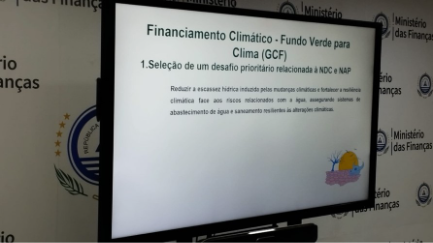
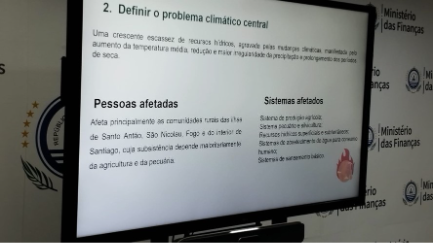
In late July 2026, the National Secretariat for Climate Action (SNAC), in its capacity as the National Designated Authority (NDA) to the GCF, organised, in collaboration with LuxDev, a seminar on the Green Climate Fund’s Project Development Guide.
Bringing together representatives from public institutions and local authorities, this training session aimed to strengthen national capacity in identifying, structuring and preparing climate projects that meet the GCF’s requirements.
Against a backdrop of the growing impacts of climate change – notably recurrent droughts, water scarcity, coastal erosion and an increase in extreme weather events – participants were trained in the various stages of the GCF project development cycle.
During the workshop, a draft version of the Project Development Handbook tailored to the Cabo Verdean context was presented as a practical tool designed to support national institutions in preparing high-quality concept notes and funding proposals. Technical sessions, case studies and practical exercises provided an opportunity to explore several key topics in greater depth, such as the GCF’s investment criteria, the theory of change, climate rationale, results frameworks, feasibility studies, budgeting and stakeholder consultation processes.
This participatory approach also enabled participants to work on several priority project ideas for Cabo Verde and to contribute to the development of a climate investment portfolio aligned with national priorities.
- Preparing for the Ministry of Finance’s accreditation
Building on these efforts, a second seminar was held in September 2026 to strengthen public sector stakeholders’ understanding of the GCF’s fiduciary standards and to support the Ministry of Finance’s accreditation process as a Direct Access Entity (DAE).
The opening ceremony was attended by the National Secretary for Climate Action, the Special Adviser to the Minister of Finance, and LuxDev, who emphasised the strategic importance of this initiative for the country.
Accreditation is a key milestone that would enable Cabo Verde to access resources from the Green Climate Fund directly and to manage this funding through its own institutions.
An approach based on strengthening national systems
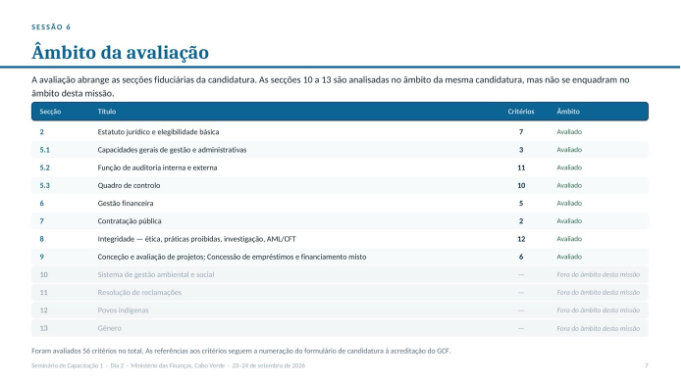
The accreditation process is based on an in-depth analysis of national public financial management systems to assess their compliance with the GCF’s fiduciary requirements in areas such as governance, financial management, public procurement, internal control, audit and accountability.
The approach adopted prioritises strengthening and building on existing mechanisms rather than creating parallel systems. It aims to identify the strengths of national arrangements, by highlighting areas requiring improvement in order to sustainably support the country’s capacity to manage international climate finance.
During the seminar, participants reviewed the preliminary results of the institutional capacity analysis and helped to validate the findings, as well as to identify the evidence and priority actions required to continue the accreditation process.
Institutional mobilisation in support of climate action
The various activities organised as part of the project have mobilised a wide range of institutional stakeholders. In addition to departments within the Ministry of Finance – notably the National Planning Directorate, the National Budget and Public Accounts Directorate, the Treasury Directorate, the General Inspectorate of Finance and the Project Management Unit (CIPP) – several audit and regulatory bodies, as well as local authorities, also took part in the work. This involvement illustrates the importance of a coordinated approach bringing together stakeholders from the fields of planning, financial management, supervision, audit and project implementation to strengthen the country’s access to climate finance.
Strategic support towards increased access to climate finance
Through these various activities, the project simultaneously contributes to the development of a portfolio of high-quality climate projects and to strengthening the institutional capacities required to access resources directly from the Green Climate Fund.
By supporting Cabo Verde in these two complementary areas, LuxDev and its partners are backing the country’s efforts to strengthen its autonomy in mobilising international climate finance and to accelerate the implementation of its priorities regarding climate change adaptation, resilience and sustainable development.
Laurence Janssens