
Climate action in Cabo Verde is losing its abstraction, as it had to. The reality is increasingly visible in our everyday life, from the rising temperatures affecting public health, the mounting pressure on our coastal ecosystems, and the severe infrastructure damage left by extreme weather in Santiago and São Vicente. But as these challenges escalate, a powerful transition is taking root across our islands. Conventional rhetoric is giving way to something far more valuable: actionable knowledge, structured organization, and active civic participation.
This edition captures a definitive turning point. We are finally moving science out of isolated technical debates and putting it straight to work on the ground. Step onto the islands, and you will see the TAOLA+ Network integrating critical biodiversity data directly into the management blueprints of our protected areas. There is no longer a gap between what we study and what we apply.
In recent months, climate action in Cabo Verde has been taking on an increasingly concrete form. The impacts remain evident in everyday life, whether through the rising temperatures, pressure on ecosystems, or the difficulties faced by many communities. At the same time, more consistent responses are beginning to emerge, based on knowledge, organisation and participation.
This edition reflects such a profound moment of transition. In several of the articles, knowledge production no longer remains confined to technical debate, in quite an obvious way. Science is beginning to have practical applications, whether through studies on the effects of heat on public health or by strengthening biodiversity data that help guide decisions. There is, in this collection of climate news, a clear convergence between what is studied and what is applied.
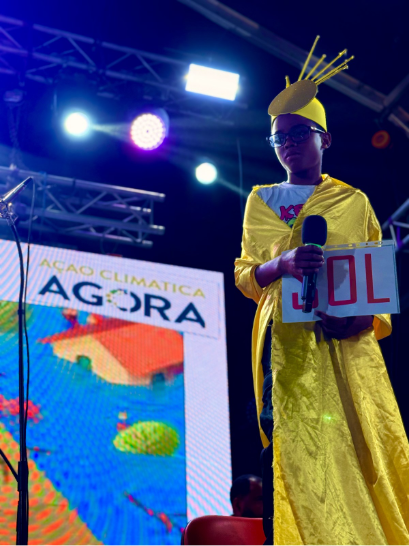
Crucially, this shift is occurring far beyond the institutional level. Our citizens are in fact driving it. Take, for instance, the 44 young leaders at FoJAC 2026 who did not just attend lectures in Boa Vista but developed immediate community interventions based on their field visits to the Sal Rei salt pans. In Paúl, Santo Antão, more than 700 pupils, 120 teachers and hundreds of parents and caregivers participated in Children’s Month activities under the theme “Today’s children, tomorrow’s climate guardians”, demonstrating how climate literacy is becoming embedded in schools, families and communities. In our classrooms and military bases, an unconventional alliance of teachers and active soldiers is treating the UN SDGs not as abstract concepts, but as a practical “climate compass” for daily operations. We are proving a fundamental truth: climate action is only sustainable when it is embraced by those who directly experience its effects.
Beneath this dynamic energy, a concrete structural foundation is locking into place. Local authorities are moving forward with PLACs/SEACAPs municipal roadmaps to set clear priorities and guide real investments into critical defenses, including halting landslides in Brava or preventing wildfires in Monte Gordo. Backstopping these efforts, Green Climate Fund projects CVE/802 and CVE/803 are successfully bridging the gap between national policy and local survival.
What we see, taken as a whole, is not merely a collection of isolated initiatives, but rather an evolving, coordinated process. Cabo Verde’s climate strategy is becoming more concrete, more integrated, and closer to the ground. The challenge going forward will be to maintain this momentum, secure these efforts, and scale them up across the entire archipelago.
Happy reading.
Loriana Monteiro