
The beach of the Costa Fragata Natural Reserve, on the island of Sal, is one of the most valuable sites for coastal biodiversity conservation in the archipelago. Each year, approximately 23% of the island’s loggerhead turtles (Caretta caretta) nest here, making this location a key site for the species. Furthermore, it is possibly the most visited protected area in the country: every day, tourists arrive on foot, in organized quad-bike tours, on horseback, by bicycle, or in off-road vehicles. During the windy season, the beaches become a world-renowned spot for kitesurfing, while in summer they transform into the setting for one of Cape Verde’s most admired natural spectacles: sea turtle nesting under the moonlight.
However, this intense tourism has put the reserve’s most fragile and characteristic habitat at risk: the dune system. Motorized vehicle traffic, constant movement of people and animals, and sand extraction for construction have caused significant degradation of the dunes and the vegetation that stabilizes them. Additionally, dune degradation has increased light pollution on the nesting beach, disorienting a growing number of hatchlings, many of which die on their way to the sea near urbanized areas.

In response, the Projeto Biodiversidade Association implemented a long-term ecological restoration plan aimed at recovering ecosystem functionality and reducing the impacts of climate change and unregulated use of the reserve.
One of the main lines of action focuses on mitigating the effects of sea-level rise and light pollution by regulating access and activities within the protected area. Specific trails were created, quad-bike access to dune areas was restricted, and informational signage was installed to raise visitor awareness about the importance of the project.
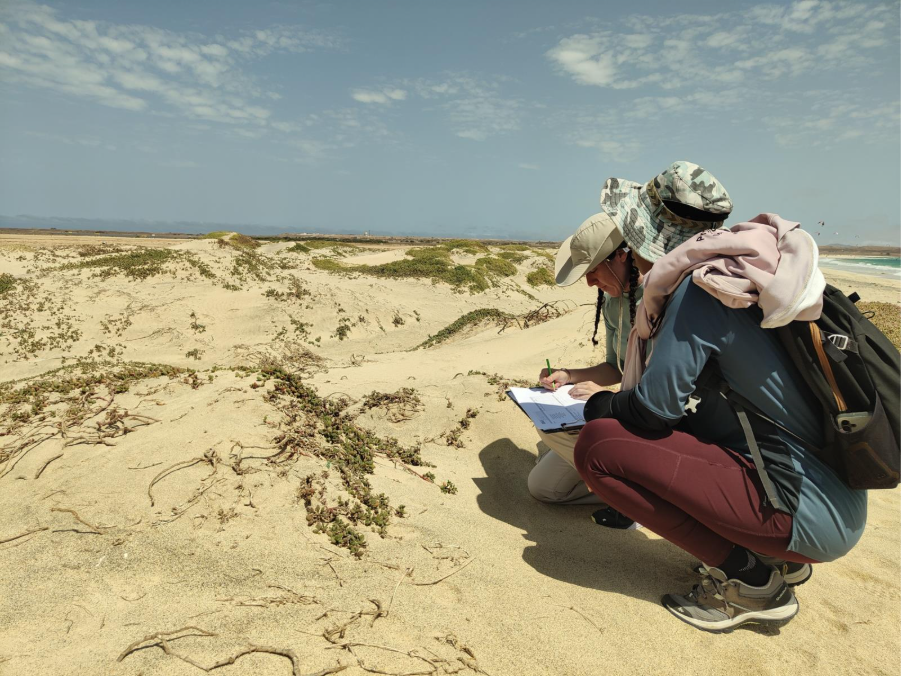
In collaboration with the Sal Ministry of Agriculture and Environment delegation and the Geography, Geographic Information Technologies and Environment Group at the University of Las Palmas de Gran Canaria, the team succeeded in fencing over 4.2 kilometers of coastal dunes, protecting approximately 85 hectares of this ecosystem, which is currently undergoing recovery. The fencing was built with more than 1,400 wooden posts made from Acacia americana (Prosopis juliflora), an invasive exotic species introduced in the 1980s for reforestation and desertification control, but which negatively affected native flora. This approach not only restores the dunes but also gives a new use to materials from invasive species control.
With the dunes better protected from human traffic, the active restoration phase begins. Projeto Biodiversidade operates a nursery of native and endemic plants, producing specimens for reintroduction in degraded areas. Highlighted species include Polycarpaea caboverdeana and Suaeda caboverdeana, endemic to the archipelago and threatened by habitat loss. Key species such as Tetraena fontanesii, Tamarix senegalensis, and Arthrocaulon franzii are also used, essential for fixing sand, stabilizing dunes, and promoting their natural growth. Increasing dune volume reduces light pollution and improves hatchling orientation toward the sea during nesting nights. Over 850 plants were planted throughout 2025, with another 1,000 expected to be reintroduced by year’s end.

Another essential element in the process is sand collectors, structures made from common cane (Arundo donax), another controlled exotic species imported from other islands such as São Nicolau or Boa Vista. These collectors are placed in the most degraded areas — usually flood-prone zones where saline crusts prevent plant germination — helping reduce wind speed and retain sand grains, facilitating the formation of a new surface layer for later planting with native species.
The results are encouraging: within a few months, rapid recovery of the dune relief and associated vegetation is observed, reinforcing the natural protection of beaches against marine erosion and improving resilience to climate change impacts. This restoration process strengthens the coast’s adaptive capacity to sea-level rise and storms while creating more stable and functional habitats for coastal biodiversity. Additionally, the project contributes to the conservation of nesting turtles and their hatchlings, while ensuring the preservation of one of Sal Island’s most valuable tourism resources: its beaches.

In short, this is a science-based restoration that seeks not only to beautify the landscape but also to recover the ecological functionality of the system. The ultimate goal is to restore natural processes — wind-driven sand transport, vegetation succession, and coastal dynamics — that ensure ecosystem resilience against current and future climate threats. In this context, restoring dunes represents one of the most effective Nature-Based Solutions (NbS) to protect biodiversity, mitigate climate change impacts, and ensure a sustainable balance between conservation and tourism development.