
In the municipality of Mosteiros, on the island of Fogo, the sea is more than a resource — it is a way of life. Artisanal fishing provides the main livelihood for hundreds of families and forms one of the local economic foundations. With an ocean coastline of over 20 kilometers and approximately 113 fishers, 37 boat owners, 16 fish vendors, and 41 vessels, the sector today faces serious challenges caused by climate change. Warming waters and ocean acidification have altered species distribution, pushing pelagic fish away from the coast and increasing fishing effort, with direct impacts on the economy and food security of local communities.
In response, the Climate Action Programme (PAC), implemented by the Ministry of Agriculture and Environment with support from Luxembourg Cooperation, and under the framework of the Operational Partnership Agreement with the Institute of the Sea (IMar), developed the pilot project “Mosteiros Resilient: Sustainable Fisheries Management and Marine Resource Valorization.” The project aims to promote the adaptation of artisanal fishing to climate change through the capacity building of local operators and the introduction of sustainable technologies.
Between October 28 and 29, one of the main achievements was witnessed: the deployment of four Fish Aggregating Devices (FADs) along the Mosteiros coast. These floating structures, installed between 0.4 and 0.5 nautical miles from the shore, increase artisanal fishing productivity, reduce fuel consumption, and relieve pressure on marine habitats. The FADs were built and installed with direct participation from fishers, with technical support from IMar and the Projeto Vitó Association, which also coordinates the “Guardians of the Sea” initiative dedicated to marine ecosystem monitoring and protection.

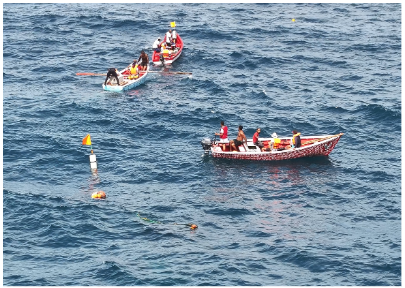
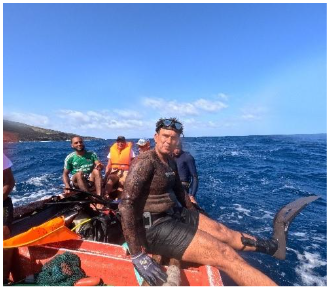
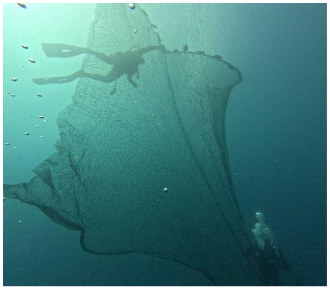
Figure 1 – Practical training of fishers in FAD construction at the Mosteiros Fishermen’s House facilities and installation of FADs along the coastal area of Mosteiros (Ribeira de Sumba; Cais Beach; Fundom de Relva Zone and Traz de Baixa), October 2025.
Simultaneously, capacity-building activities were conducted in fish handling, processing and valorization, hygiene and food safety, as well as Small Business Planning and Management, benefiting 30 artisanal fishing operators, including fishers and fish vendors. These trainings strengthened local technical and entrepreneurial skills, promoted income diversification, and highlighted the role of women in the fishing value chain.
The “Mosteiros Resilient” project demonstrates that climate resilience is built locally, through cooperation between institutions and communities. The partnership between PAC, IMar, the Mosteiros Municipal Council, the Fishermen’s Association, and the Projeto Vitó Association constitutes an example of inclusive and sustainable climate action, capable of inspiring future interventions in other coastal municipalities of Cabo Verde.
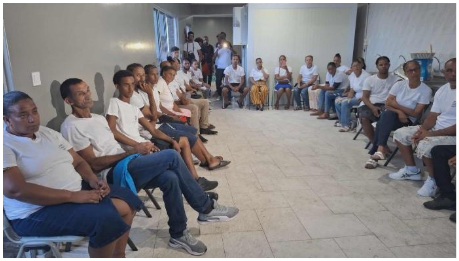

Figure 2 – Closing session of training and capacity building in Small Business Planning and Management for fish vendors and fishers, with the handover of equipment to the Mosteiros Fishermen’s Association.
The sea will continue to be the soul of Mosteiros — and climate action, the force that ensures its future.
Author: Nilton Gomes
Technical Assistant, Local Action – Climate Action Programme
Coordination: Inês DE SOUSA MOURÃO
Technical Coordinator – Climate Action Programme