
Cape Verde is making steady progress toward energy sustainability with the pumped storage power plant project, Santiago Pumped Storage, to be built in Chã Gonçalves, in the municipality of Ribeira Grande de Santiago – Santiago Island. This infrastructure will significantly increase energy storage capacity, enabling higher electricity production from renewable sources, ensuring energy independence and security, and supporting climate adaptation.
With an installed capacity of 20 megawatts (MW) and an energy storage capacity of 179 megawatt-hours (MWh), Santiago Pumped Storage represents a pioneering and strategic project in Cape Verde, aligned with national efforts to achieve ambitious clean energy production targets.
Its implementation is based on multiple studies conducted since 2011, which considered environmental and social constraints. These culminated in the Environmental and Social Impact Assessment (ESIA), including fieldwork carried out in 2024.
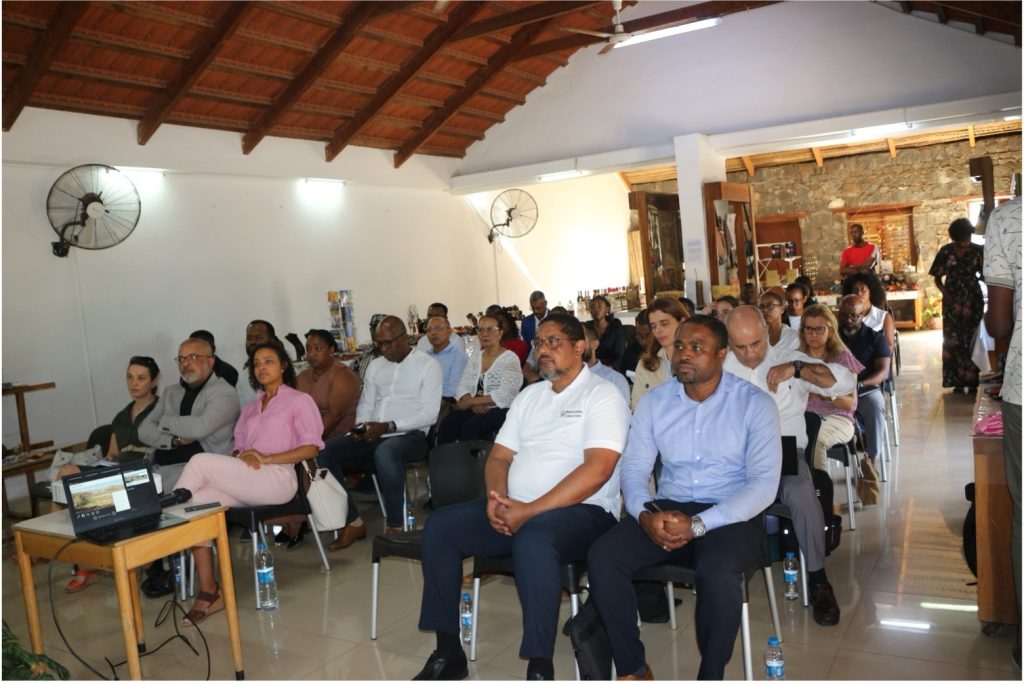
On November 6, the National Directorate of Industry, Commerce and Energy, with support from the Energy Transition Support Program funded by Luxembourg Cooperation, held a workshop at the Ribeira Grande Cultural Center to present and discuss the ESIA results. The session included representatives from the communities of Chã Gonçalves and Beatriz Pereira, the local municipality, the National Directorate of Environment, the National Institute of Public Health, the Cultural Heritage Institute, among other stakeholders and institutions involved in the process.
The study concluded that the project is environmentally and socially feasible, provided that the proposed measures are implemented and rigorously monitored, including:
- Implementation of the Stakeholder Engagement Plan, including a grievance management mechanism;
- Livelihood restoration plan;
- Access, fencing, and other safety measures to prevent unauthorized and unsafe access to risk areas;
- Noise and vibration management to avoid disturbing residents, and measures to prevent electrocution or bird collisions with power lines;
- Emergency response plan;
- Recruitment plan, grievance mechanism for workers, and a code of conduct to ensure compliance with environmental, social, health, and safety requirements, and to prevent gender-based violence (GBV) and sexual violence against children, youth, and women, among other mitigation measures.
The Minister of Industry, Commerce and Energy, Eng. Alexandre Monteiro, who presided over the workshop, stated that the Santiago Pumped Storage project represents “the symbol of Cape Verde’s energy future, based on sustainability, innovation, and energy independence.” Alexandre Monteiro also emphasized that conducting the ESIA reinforces the country’s commitment to national and international best practices in the implementation of large-scale energy infrastructure, promoting compliance with environmental and social standards while fostering dialogue with all stakeholders about the project’s relevance for the national energy future. Beyond environmental benefits, the project will deliver significant economic and social impacts, including the creation of direct and indirect jobs during construction, boosting local economic activities, and revitalizing the municipality of Ribeira Grande de Santiago. Direct social benefits are also planned, such as enhanced desalinated water supply to neighboring communities and urban and housing rehabilitation in the two communities closest to the facility.
The plant will store large quantities of energy from the “sun and wind,” ensuring continuous supply even during periods of low solar radiation or wind. This infrastructure will complement the production of existing and expanding wind and solar farms on Santiago Island, creating a more efficient, stable, and balanced electricity system. With this infrastructure, the country takes a decisive step toward achieving more than 50% renewable energy penetration by 2030, a target set in the 2018–2040 Electricity Sector Master Plan. In addition to increasing production capacity, the project will contribute to the resilience and stability of the national electricity system.
Part of the Global Gateway Facility package, the project represents an investment of EUR 79 million and has the support of Luxembourg Cooperation in the development of key technical studies, including the preparation of tender documents for construction. Construction is scheduled to begin in 2026, with operations starting in 2029, aiming to inject 7% renewable energy into the national grid and 18% into Santiago Island’s network.
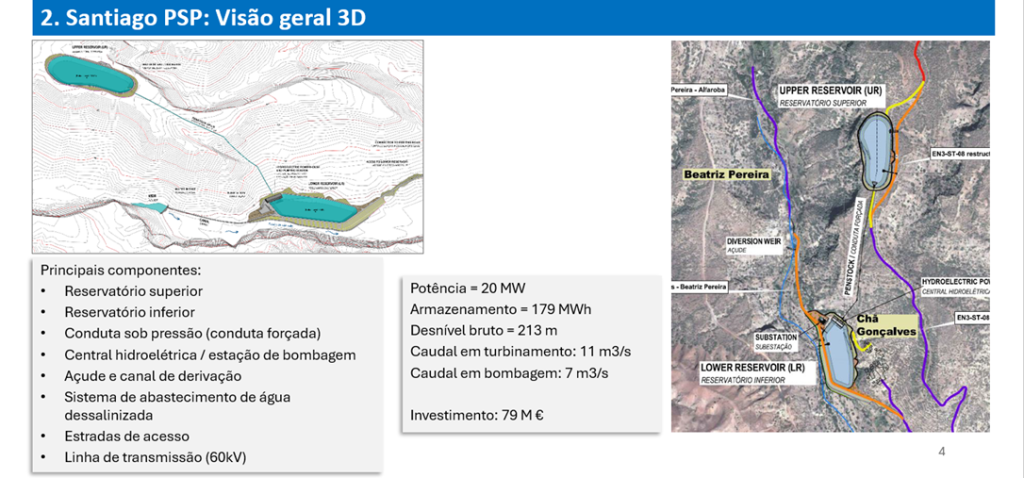
The facility will operate using two reservoirs with capacities of 396,000 and 353,000 cubic meters (m³) of water, enabling storage of surplus wind and solar energy through a pumping system. This mechanism is expected to reduce fossil fuel consumption for electricity generation by 22%. Additionally, a desalination plant with a capacity of 1,000 cubic meters of water per day will be built to compensate for evaporation losses. A new 60kV high-voltage line and two substations will also be constructed to connect the storage plant to Santiago Island’s electricity system.
With Santiago Pumped Storage, Cape Verde takes a decisive step toward a cleaner, more stable, resilient, and independent electricity system.