
Climate action will only be truly effective when its concepts are understood, embraced, and put into practice by communities.
It was with this purpose in mind that the Multidialectal Glossary of Climate Change Terms in CaboVerdean was published, an initiative developed as part of the Climate Action in Higher Education Project, implemented by the University of Cabo Verde (Uni-CV) with support from the Climate Action Program funded by Luxembourg Cooperation.
Communicating to Bring People Together
When it comes to technically complex and cross-cutting issues such as climate change, communication is just as important as science. Concepts such as adaptation, mitigation, erosion, drought, renewable energy, or flooding may be part of communities’ daily lives, yet often the specific terminology used to describe them in the Cabo Verdean language is not collected and documented, converted into scientific outreach materials, and made available to the broader public.
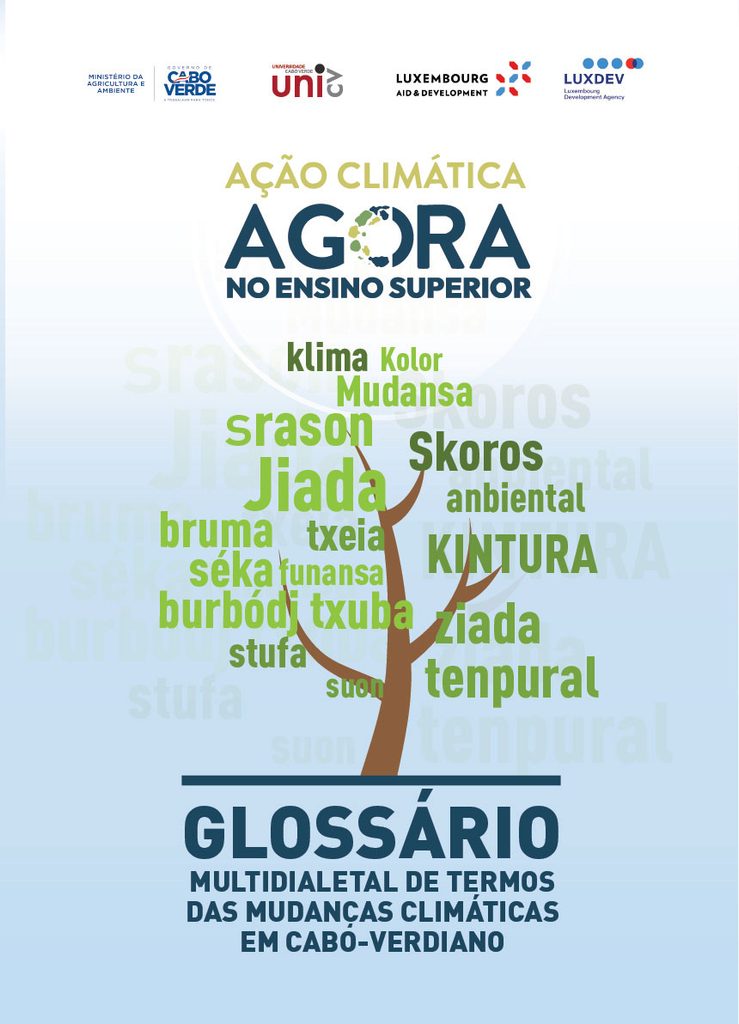
The glossary seeks to fill this gap, making knowledge more accessible, relatable, and relevant to different audiences. Based on linguistic fieldwork, the publication highlights Cabo Verde’s linguistic diversity by documenting and describing climate-related vocabulary in the dialects of Fogo, Santiago, São Nicolau, São Vicente, and Santo Antão, and providing their equivalents in Portuguese.
Climate conservation is also linguistic conservation, since the loss of biodiversity entails the loss of linguistic terms and expressions. Recognizing, naming, and describing emerging phenomena is the first step toward taking action.
Professor Ana Karina Moreira
A scientific methodology rooted in the local context
The development of the glossary was coordinated by Professors Dominika Swolkien and Ana Karina Moreira, linguists at Uni-CV and researchers with extensive experience in the study of the Cabo Verdean language, including the description of its dialectal varieties and lexicographical research. The scientific expertise of the coordinators, combined with the work of a team of young researchers from the Bachelor’s program in Cabo Verdean and Portuguese Studies, ensured the linguistic and methodological quality of the publication.
The compilation of the glossary was coordinated by Professors Dominika Swolkien and Ana Karina Moreira, linguists at Uni-CV and researchers with extensive experience in the study of the Cabo Verdean language, including the description of its dialectal varieties and lexicographical research. The scientific expertise of the coordinators, combined with the work of a team of young researchers from the Bachelor’s program in Cabo Verdean and Portuguese Studies, ensured the linguistic and methodological quality of the publication.
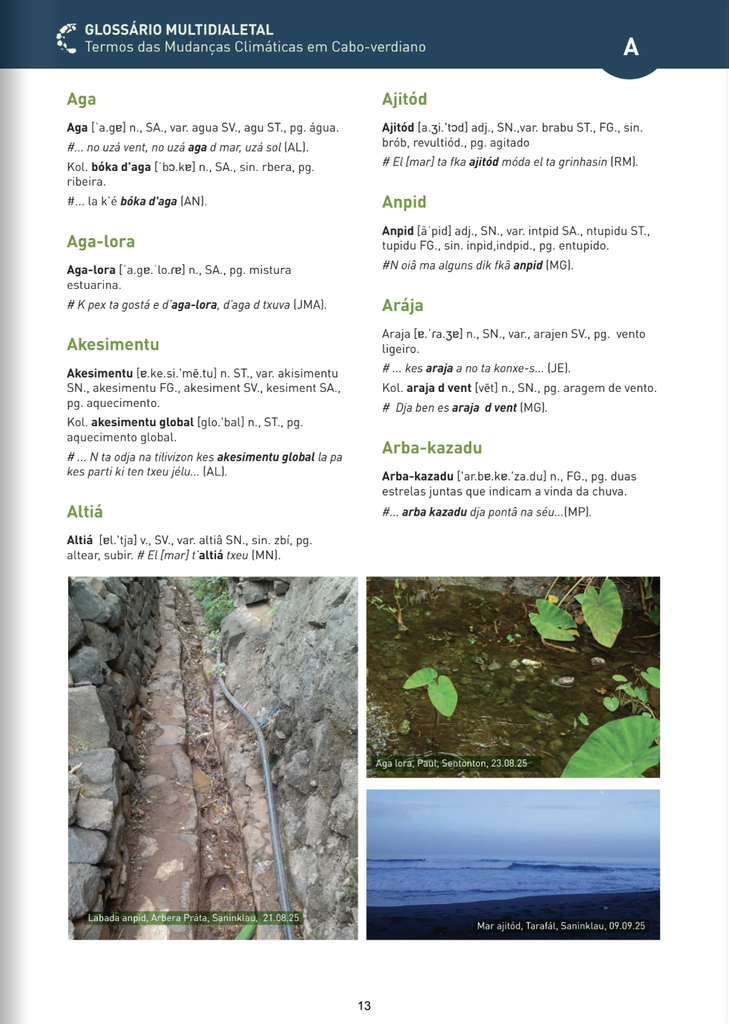
Each lexical entry presents the recorded form written in the Cabo Verdean Alphabet (2009), the phonetic transcription in the International Phonetic Alphabet (IPA), the grammatical category, the geographic variety, synonyms and other forms in the Cabo Verdean language, a translation into Portuguese, and a real-life example of usage. Whenever possible, illustrative images with captions explaining the terms were included. This rigor makes the glossary a reference work and a milestone for Cabo Verdean lexicography.
Local Knowledge for More Inclusive Climate Action
The glossary demonstrates that language is also part of the response to climate challenges. When people are able to connect scientific concepts with words, expressions, and references from their daily lives, their ability to understand risks, participate in decision-making processes, and adopt adaptation measures better suited to their realities increases.
Although studies on Cabo Verdean lexicography date back to the 19th century, dictionaries published to date have focused primarily on the Santiago variety. This glossary fills an important gap by proposing a multidialectal approach, grounded in fieldwork data, thereby contributing to the documentation and understanding of the intrinsic richness of the Cabo Verdean language.
Professor Dominika Swolkien
By supporting this initiative, the Climate Action Program reaffirms its commitment to people-centered climate action that values local knowledge and promotes access to information in formats appropriate to the Cabo Verdean linguistic context. Because taking action against climate change also means speaking the language of the communities that live with its impacts on a daily basis