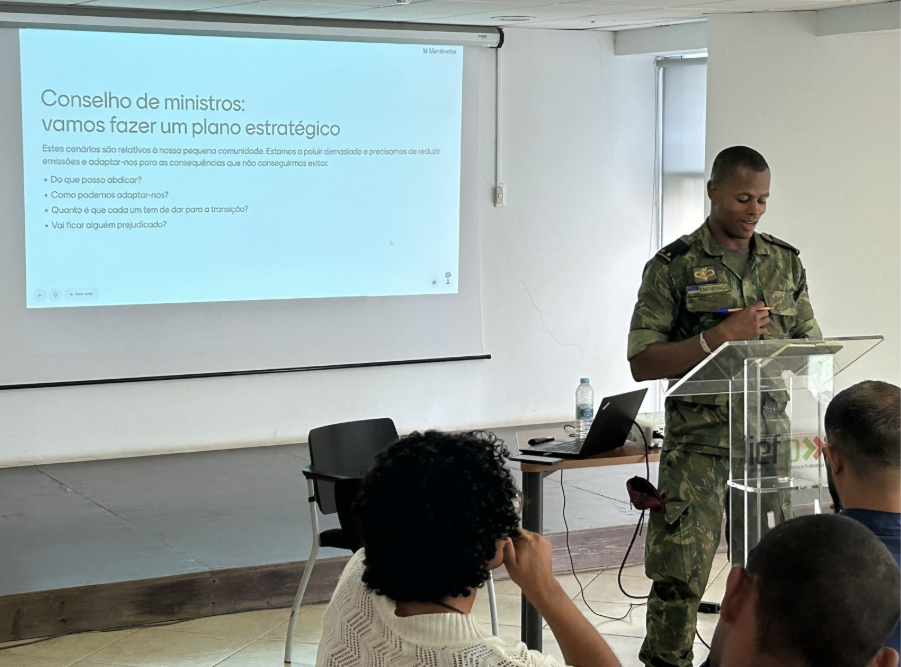
From May 5th to 7th and then from May 13th to 15th, the “Climate Action NOW” trainer training took place, organized as part of the Climate Action Programme’s climate literacy project. These two sessions, each lasting three intensive days, brought together an unlikely group of professionals from all areas, including youth organizations, public institutions, teachers, and military personnel, all committed to a common goal: strengthening their capacity to act and train others in responding to climate change.
This specific meeting of “unconventional” actors was expected to yield new ideas, synergies, and solutions to strengthen Cabo Verde’s climate resilience.
Understanding the problem, acting on evidence
Before any action is taken, a deeper understanding of the problem and its causes is necessary. Therefore, the training focused on highlighting universally recognized and empirically proven scientific climate evidence, addressing global warming, which is largely due to human activities on a global scale.
Throughout her presentation, the trainer warned that in Cabo Verde, these impacts are already visible: increased intensity and frequency of extreme weather events resulting from rising temperatures and decreased or increased rainfall, manifesting as heat waves, droughts, or floods.
As a small island state, the country faces ever-increasing vulnerabilities, requiring informed, planned, and sustainable responses. In this sense, participants learned to apply climate data and local vulnerability scenarios to their own sectors, identifying concrete entry points for action in education systems, public administration, and operational units such as the armed forces, ensuring that climate action is also fair and inclusive, protecting the most vulnerable groups.
This approach allowed participants to identify specific niches where their skills could be useful. Based on this principle, the focus quickly shifted to action, with an analysis of the following central pillars: mitigation, adaptation, and response to loss and damage, using concrete examples dependent on national policies, such as the commitments made under the Paris Agreement, for practical solutions on the ground.
Following this transition, one of the military personnel present recalled that “the Sustainable Development Goals (SDGs) represent a remarkably useful tool, a kind of simplified climate compass, that allows us to discern where our action can generate the greatest impact.”
From strategy to local action: governance and communities at the heart
One of the main strengths of the training program was demonstrating that climate action depends not only on large global decisions, but also on coordination between different levels and stakeholders. Government, the private sector, and civil society have complementary roles, and the effectiveness of policies depends on how well these actors are coordinated.
However, it was at the local level that the message gained real meaning, as it became even clearer that communities are the most effective agents of climate resilience; they are the ones who identify risks, implement solutions, and ensure the sustainability of these actions. Regardless of the social and professional role we play, we must all be committed to combating climate change, which affects everyone.
Concrete action plans to address real local challenges were developed by the participants, such as reforestation, water resource management, the construction of community gardens, and clean energy projects.
By the end of the third day, it was clear that policies only take shape when public engagement comes into play. Thus, the participants successfully integrated one of the central messages of the training: it’s not just about transmitting information, it’s about mobilizing people for climate action, which requires engagement, adapting messages to different audiences, and using accessible tools.
Participants thereby learned how to interact with each communication platform, whether traditional media such as television and radio or digital social media, depending on the target audience they wished to reach.
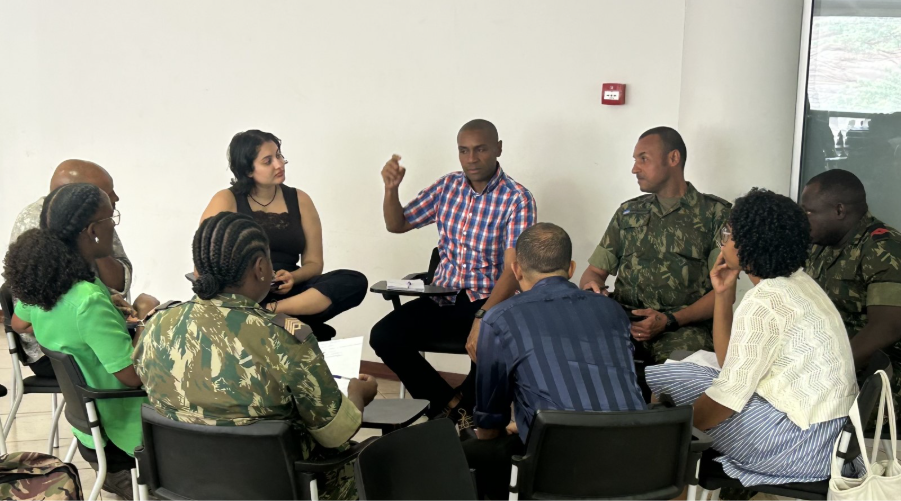
A decisive step towards a more resilient future
At the end of the training, the trainer, Laura Pereira, emphasized that “these professionals are now equipped with the tools to further train their colleagues, which means that even more teachers and military personnel will be better prepared for the challenges presented by the climate crisis and for the fundamental principles of climate action, which they can apply depending on their area of expertise or specialization.”
Upon returning to their organizations, participants were encouraged to promote initiatives and integrate climate action into their daily work. As became clear during the sessions, the response to climate change in Cabo Verde will increasingly depend on the collective capacity to act locally, in a coordinated and sustainable way.
“What struck me most about this training was that it completely changed how I see my role. We are not only preparing young people for a constantly evolving job market, but also for the worsening climate scenario. Now I feel much more responsible for including these concepts in our training process, so that the next generation is better prepared to respond to these challenges,” concluded the trainee representing the Institute of Employment and Vocational Training.