
On 11 September 2025, in the city of Praia, the Government of Cape Verde presented the Strategic Plan for Mobilising Climate Support (PEMAC), an instrument aimed at strengthening the mobilisation of climate finance and accelerating the country’s energy transition, resilience, and decarbonisation by 2030.
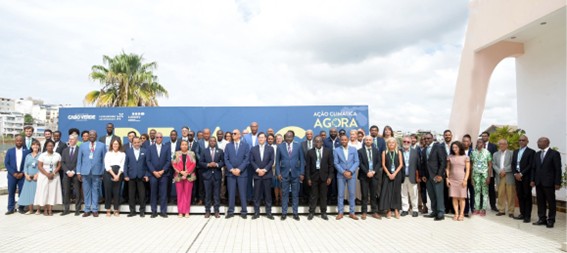
The official launch of PEMAC was led by the Ministry of Finance (MF) and the Ministry of Agriculture and Environment (MAA) of Cape Verde, with funding from Luxembourg Cooperation, and took place in a hybrid format. The objective was to present the plan to a broad audience of partners interested in supporting the country’s development along a climate-resilient and low-carbon pathway. The launch followed Cape Verde’s participation in the 29th Session of the Conference of the Parties to the United Nations Framework Convention on Climate Change (COP29) in Baku, within the context of preparations for COP30 in Belém and the development of NDC 3.0, thereby reinforcing the country’s leadership in climate action.
The ceremony was chaired by the Deputy Prime Minister and Minister of Finance, Olavo Correia, who presented the Plan, and was attended by senior national officials, including the Minister of Agriculture and Environment and the Minister of Industry, Trade and Energy, who delivered high-level speeches on Cape Verde’s Climate Policy, Energy Transition, and Climate Action.
The event brought together representatives from the Ministries of Environment and Finance of CPLP countries, as well as other international organisations and development partners of Cape Verde. Members of the diplomatic corps, public administration, academia, municipalities, the private sector, and civil society organisations were also present, fostering an open and critical dialogue on the international climate finance landscape and the challenges it poses for the country.
On behalf of the Grand Duchy of Luxembourg, a key partner in the development of Cape Verde’s climate governance, a video message was delivered by the Minister for the Environment, Climate and Biodiversity, Mr Serge Wilmes. In his address, he highlighted the Development–Climate–Energy nexus within Luxembourg Cooperation. The event also included the participation of the Ambassador of Luxembourg to Cape Verde, Mr Jean-Marie Frentz, who welcomed Cape Verde’s efforts and achievements in climate action and in mobilising climate-related resources.
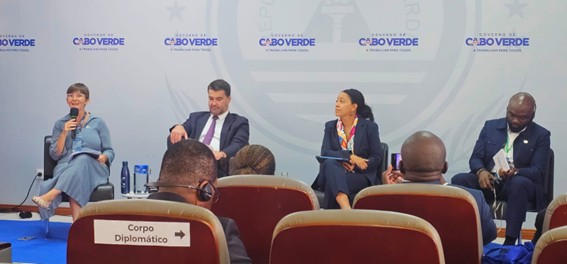
The agenda also featured a panel discussion bringing together representatives of key institutions within the international climate finance ecosystem, both bilateral and multilateral: the Ambassador of Portugal to Cape Verde, Mr João Queirós; the Director for European and International Affairs of the Government of Luxembourg, Mr Andrew Ferrone; the Head of the Central North and West Africa Sub-Region of the Green Climate Fund (GCF), Mr Ibrahima Bamba; the Senior Climate Change Specialist and Coordinator at the Global Environment Facility (GEF), Mr Filippo Berardi; the Resident Representative of the World Bank Group in Cape Verde, Ms Indira Campos; and the Regional Coordinator of the United Nations Framework Convention on Climate Change (UNFCCC) for West and Central Africa, Mr Walters Tubua. The panel was moderated by the Technical Coordinator of the Climate Action Programme, Ms Inês Mourão.
What is PEMAC and how did it emerge?
In the face of the global threat that has affected the world, putting at risk life on the planet and future generations—climate change—Cape Verde has not been spared its impacts, but it has also not remained indifferent in its response. As a Small Island Developing State (SIDS), the country is responsible for a very small fraction of global emissions (around 0.002%), yet the cost in terms of consequences is enormous. For this reason, Cape Verde cannot remain idle. It has a moral and political obligation to place itself at the forefront of the call for global climate action. The country’s commitment to the climate agenda is long-standing and solid. It has ratified the main international instruments, from the United Nations Framework Convention to the Paris Agreement, and has honoured its commitments through reports, strategies, and national plans that demonstrate its determination to align climate policy with the Sustainable Development Goals (SDGs).
Cape Verde has defined and is consolidating its Climate Governance Framework through concrete bodies and instruments. These include the creation of the Interministerial Council for Climate Action, the National Council for Environment and Climate Action, the National Secretariat for Climate Action, and the Citizen and Climate Forum, aimed at strengthening the participation of civil society and the private sector. A Climate Policy Law is currently in the approval phase, and the Environmental Climate Fund is under development. The country has also designed a transparency system that facilitates the communication of requested and received support in line with the Paris Agreement and is implementing climate tagging processes.
It is within this trajectory that PEMAC emerges as a structuring instrument, offering an integrated and coordinated approach to address the critical challenge of mobilising financial, technological, and institutional resources. These resources will enable Cape Verde to face the impacts of climate change while simultaneously building a sustainable and inclusive development model. “More than a technical document, it is a compass that will guide the country on the path towards a just, resilient, and low-emissions transition,” emphasised His Excellency the Deputy Prime Minister and Minister of Finance, Olavo Correia, at the opening of the Conference.
PEMAC was developed by the Ministry of Finance, through the National Directorate of Planning, with the support of Luxembourg Cooperation. It is aligned with key instruments such as the Nationally Determined Contribution (NDC), the National Adaptation Plan (NAP), and the Long-Term Low-Emission Development Strategy (LT-LEDS CV 2050). The Plan clearly and objectively structures the country’s financing needs, identifies priority projects, and opens the way for new strategic partnerships with the international community.
Key takeaways from the Conference / Practical recommendations
The Conference provided a meaningful space for joint reflection on the major challenges and significant opportunities that Cape Verde faces in the field of climate action. At a time when other countries are redirecting political and budgetary priorities towards critical issues such as climate, water, and the environment, Cape Verde is no exception. The costs required to invest in ambitious climate action are high—over EUR 5 billion by 2050, approximately EUR 210 million per year. However, according to World Bank data (Country Climate and Development Report – CCDR), the economic and social costs of inaction may be even higher.
Against this challenging backdrop, high-level interventions highlighted three key messages:
- The urgency of climate action – the real and recent impacts of Storm Erin, which affected the country’s three northernmost islands, highlighted the vulnerability of the territory and the need to strengthen the resilience of populations and infrastructure;
- The existing political and strategic alignment, with instruments such as the NDC, the NAP, the LT-LEDS 2050, and now PEMAC;
- The importance of international cooperation and solidarity, emphasised by representatives from Luxembourg, the World Bank, the Green Climate Fund, the UNFCCC, and others who shared experiences and expressed their willingness to strengthen partnerships with Cape Verde.
To enable the implementation of PEMAC and address the urgency of climate action, Cape Verde will still need to face three critical challenges, as highlighted by Olavo Correia:
- Reducing the gap between ambition and implementation, as climate action is demanding and transformative, and current results fall far short of expectations;
- Reducing the gap between the public and private sectors, since climate action is not only a public responsibility but also, and above all, a responsibility of the private sector, from which much of the required climate finance must be mobilised;
- Bridging the gap between urgency and bureaucracy, which implies simplifying access to financial envelopes for the implementation of climate projects, both nationally and internationally.
The panel discussion that brought together key partners from the international finance ecosystem was particularly rich and enabled an exploration of climate finance instruments available to Cape Verde, ranging from multilateral funds to bilateral partnerships and innovative mechanisms such as green and blue bonds, or debt-for-climate investment swaps.
The debate also identified potential synergies between multilateral, bilateral, and private mechanisms, addressed additional instruments and opportunities that could be mobilised to support PEMAC implementation, and acknowledged the access challenges faced by Small Island Developing States.
Several insights and practical lessons were highlighted on how Cape Verde can leverage climate finance: presenting impactful and bankable projects; aligning national needs with the funding opportunities of major funds such as the GCF, GEF, and Adaptation Fund; and promoting integration, national ownership, co-financing, community participation, and transparency.
At the closing session, the National Director of Planning, Gilson Pina, provided a very positive assessment of the PEMAC presentation and emphasised the importance of integrating climate issues across all national plans and policies. He also noted that the country is now well positioned to seize the diverse financing opportunities available.
The Conference exemplified the momentum the country is building and its commitment to the cause of climate action, issuing a call for shared responsibility. Climate action is not an exclusive responsibility of the Government; it is a collective endeavour that requires the contribution of all, without exception.
The message was clear: There is no Plan B. “The time to act is now.”
Almerinda de Pina, Technical Officer, National Directorate of Planning / Ministry of Finance
9 October 2025